- Galeria Local Newsletter
- Posts
- Issue 4: José Farinha Interview and a Quiet Note
Issue 4: José Farinha Interview and a Quiet Note
Photojournalism Meets a Subtle Garden Memory

Jorge Silva
June 03, 2025
GALERIA LOCAL

by José Farinha
Welcome — and thank you for reading.
Sometimes, the unexpected opens new doors. This issue was meant to feature Davide Degano’s story, but unforeseen circumstances delayed our conversation and José Farinha stepped in with a timely and generous conversation that I’m thrilled to share. As photographer and co-founder of Kioskzine, one of Portugal’s most unpretentious documentary photography projects, José spoke about the political role of the image, the porous line between fiction and documentary, and the grit it takes to stay independent while reaching others. | In “Narrative Layers,” I revisit a photograph that didn’t make the final cut for Visita Guiada—a quiet image of an urban garden, subtle and unresolved, yet still resonating. This is also the last issue before the finissage of Visita Guiada. Scroll down for special offers—and a quiet way to close this journey, or perhaps meet in person. |
Interview
FROM MINES TO MEMORY:
A Conversation with José Farinha
This week, I’m sharing highlights from a rich and wide-ranging interview with Portuguese documentary photographer José Farinha — co-founder of Kioskzine, a fanzine-style publication dedicated to documentary photography in Portugal. Our conversation traversed his unexpected journey from mining engineer to photographer, the ethics of image-making, and the role of photography in public and political space.

José Farinha
A Life Reframed
Farinha’s entry into photography was unplanned: “I trained as a mining engineer and spent over a decade working on large-scale projects abroad,” he told me. “But during a year-long posting in Peru in 2002, my father gave me a 1.4-megapixel Canon Ixus. I started photographing daily life in Lima — street scenes, people, textures — and sending the images to friends back home. Their encouragement led me to see those images not just as souvenirs, but as stories.”
This casual practice became a serious pursuit. Returning to Portugal, Farinha enrolled in a film-based photography course, even as he continued working in engineering. His real turning point came during a move to London, where he immersed himself in studio lighting courses and, eventually, made the leap into full-time photography.
“I think my engineering background helped. Project management, emotional resilience, team coordination — all those skills carry over when you’re managing a long-term photographic project.”
 by José Farinha |  by José Farinha |
The Birth of Kioskzine
The idea for Kioskzine emerged in 2019, shortly before the pandemic. “I had work that had never been printed — things that lived online or had been shared around but never existed physically,” he explained. “I spoke to Paulo Pimenta, a long-time friend, and we thought: why not create a small-format publication to make photography more accessible?” Daniel Rodrigues soon joined, and together with designer Inês Branco, they launched the project — producing their first three-issue test run in early 2020.
Printing only 50 sets, they were surprised to see the edition sell out almost immediately. This confirmed the viability of a self-funded, grassroots model: affordable (€8 per issue), high-quality prints with minimal text, and a strong emphasis on tactile experience. “We want people to hold the work in their hands — not just scroll past it.”
Since then, Kioskzine has published nine issues (at the time of the interview), featuring work by names such as Pauliana Valente Pimentel, João Pina, Ana Brígida, Augusto Brázio and others. Each issue is the result of close collaboration between editors and photographer, emphasizing thoughtful sequencing and physical presence.

by José Farinha
Documentary or Artistic?
When asked about the boundary between documentary and art, Farinha is pragmatic: “For me, it depends on who you are as a person. If you are politically or socially engaged, that will reflect in your work. I didn’t decide to become an activist through photography. It’s just that I care about certain issues — like the refugee crisis, or the situation in Palestine — and I felt the need to witness them.”
He resists the idea that photography must be politically explicit to be valuable. “Trends come and go. What matters is whether the work adds something meaningful to the subject, and whether it’s done with honesty.”
We also touched on the use of fiction in documentary work. “Everything is valid, as long as it's honest and explained,” he said. “Take Cristina de Middel’s Afronauts. Nobody thought she had discovered a real space program in Zambia — it’s clearly a fictional scenario, but it points to real issues. Fiction can open a space for reflection.”

by José Farinha
Photography in Public Space
One of the final themes we explored was the role of photography outside traditional white cubes. Kioskzine has already ventured into exhibitions — first at Fórum da Maia and later at the Portuguese Photography Institute in Lisbon — transforming the publication into a physical installation.
Farinha believes public visibility is crucial: “Who visits galleries? Usually people already interested in art. But if we place photography in the street — like murals, posters, or outdoor exhibitions — it becomes something else. It enters everyday life.”
As the project evolves, the team hopes to include more emerging photographers and possibly apply for grants, but Farinha is clear: Kioskzine will remain small-scale, tactile, and focused on storytelling. “This is not a photobook,” he reminds me. “It’s a fanzine. A democratic object. A document for the future.”

For our portuguese speaking readers here is a link for the whole interview:
Narrative Layers
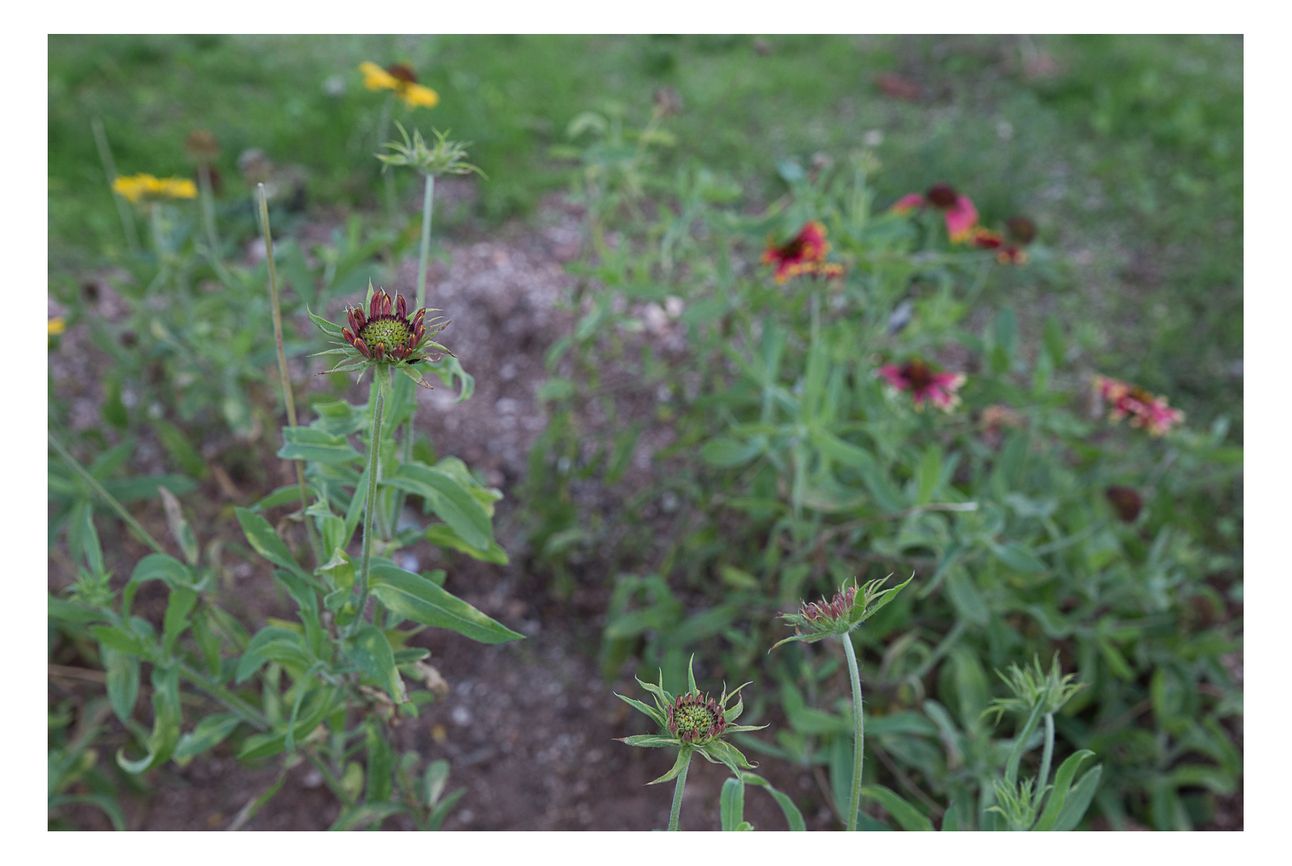
This month’s Narrative Layers features a photograph that never found its place in the final edit of Visita Guiada. It brushes against a quiet taboo in authorial photography: the fear of beauty. But what if that fear blinds us to something else — something quieter, stranger, more enduring?
PETALS
This photograph, a stray from my Visita Guiada project, captures an urban garden’s muted tangle—a rough earth line splits the frame, with a green, petal-less flower in focus amid pinks, purples, and yellows. It’s a quiet note, anchoring me in a place that did not talk to my camera that day, its banality veiling significance despite my memories. Excluded from the final edit, this subtle image is my take from that unremarkable space. In art photography, the push to be significant often creates taboos—like shunning flowers or obvious beauty—to prove the medium is more than aesthetics. Yet this understated garden, where beauty fades into restraint, hints at a quiet paradox, its narrative thriving in the unexpected.
Join Us for the Finissage – June 8
As Visita Guiada closes its cycle, we invite you to a final encounter with the work, in the space where memory, light, and silence have been held these past months. Attendance is free, but space is limited.
Let us know if you’re coming—and feel free to bring someone you love.
Special offers:
Finissage Visita Guiada
For all GL Founders:
As a thank-you for your early support as a GL Founder, I’m sharing something special: a digital print of Petals, the photograph featured in this issue’s Narrative Layers.
It’s a quiet fragment from Visita Guiada — excluded from the final edit, yet strangely persistent. Subtle, unresolved, and perhaps for that reason, enduring.
For those attending the finissage:
Everyone who joins us in person will receive the previously announced 10×15cm print, plus an extra month of premium access to the newsletter.
Just click the button bellow and show up!
Let’s close this chapter together.

“The ordinary is a very under-exploited aspect of our lives because it is so familiar.”
Martin Parr
Until next time,