- Galeria Local Newsletter
- Posts
- Issue 36: Beyond the Nostalgia for a Unified Narrative
Issue 36: Beyond the Nostalgia for a Unified Narrative
Plurality, control, and the unfolding of awareness

Jorge Silva
April 07, 2026
GALERIA LOCAL

by Jorge Silva
Welcome — and thank you for reading.
This week’s essay completes a trilogy shaped by my reading of Giambattista Vico. Across these texts, the reading serves as a starting point from which a set of ideas and questions emerge and are developed as they unfold. This is the line I will continue to work along: approaching philosophers as catalysts for thinking, allowing their work to extend into new lines of inquiry. | In parallel, the work in the field continues, extending into a new pass through the Estrada Real project. This week’s chronicle turns on an interesting question — you can find it in the Narrative Layers section. —Jorge |
The Burden of Reflection
There comes a moment in the life of societies when their own structures become visible to them. Institutions that once appeared natural begin to reveal their historical formation. Customs that once seemed inevitable begin to look like arrangements shaped by earlier generations. What had been lived as necessity becomes recognizable as a particular way of organizing experience.
This moment marks the emergence of reflection.
Reflection does not mean that reality itself becomes uncertain. Human life remains constrained by biological drives, material conditions, and the physical limits of the world we inhabit. But reflection reveals something else: the frames of reference through which societies interpret and organize those constraints. Once those frames become visible, it becomes possible to imagine that other arrangements might also exist.
Earlier societies often experienced their frameworks as unquestioned. Religious cosmologies, inherited hierarchies, and traditional authority structures provided a single horizon within which most social life unfolded. The coherence of that horizon did not necessarily produce justice or security for all who lived within it, but it did provide a shared orientation that organized meaning and authority.
When reflection spreads more widely through a society, that horizon begins to open. Scientific reasoning, legal systems, political debate, economic calculation, and cultural interpretation gradually develop their own internal logics. None fully absorbs the others. Each becomes a distinct frame through which reality can be understood and acted upon.
Plurality emerges not because societies lose the capacity for order, but because multiple frames of reference become visible at once.
Within this condition, coordination requires mechanisms capable of linking domains that differ in purpose and meaning. One of the most powerful of these mechanisms is economic exchange. Money functions as a universal translator of value. Activities that differ radically in nature — scientific research, artistic production, technological development, political organization — can nevertheless interact through the circulation of resources.
This does not mean that economic valuation determines the meaning of those activities. Science still seeks truth, law still mediates conflict, and culture still produces symbols and narratives through which societies understand themselves. Economic exchange simply allows these domains to intersect within a shared system of allocation.
The stability of modern societies therefore cannot depend on a single narrative capable of organizing all meaning. Instead it depends on the integrity of structures that allow different frames to coexist and interact without collapsing into conflict. Systems of law, scientific standards of inquiry, institutional deliberation, and open public discussion function as mediating mechanisms through which disagreement can unfold productively.
A living society resembles a living organism more than a monument. Its stability arises not from immobility but from continuous adjustment. Ideas must remain open to challenge. Institutions must remain capable of revision. Disagreements must find channels through which they can be expressed and resolved.
When these conditions hold, plurality does not threaten stability. It strengthens it.
The true danger lies not in the multiplication of perspectives but in the petrification of the structures that govern them. When institutions cease to evolve, coherence turns into dogma and stability becomes inertia.
The burden of reflection is therefore not the loss of unity but the responsibility to maintain frameworks capable of sustaining plurality. Modern societies no longer depend on a single narrative to organize their existence. They depend on the vitality of the structures through which different frames of reference can remain in dialogue without destroying the system that contains them.
Narrative Layers
This week’s chronicle marks a return to the Estrada Real project. After an initial exploration that moved between the river, the rural interior, and a series of neighbourhoods visited along the way, I decided to revisit it through a second pass, now focusing on the urban centers of each municipality — a direction that will likely extend across the entire Setúbal district.
This walk took place in Moita.
WHO CONTROLS THE WORLD?
Moita is about twenty minutes from where I live. I parked in the center and started near the river.
Part of the promenade was blocked with tape, and some metal structures had been installed on the outer side of the railing, extending slightly over the water. People were sitting there fishing, positioned outside the railing.
A young girl stopped and looked at the scene. She seemed amused. Then she asked me if all this was just for fishing, as if putting into words my own unspoken perplexity.
 by Jorge Silva I continued along the river. A man was sitting on a motorbike, with a sharply defined beard. His name was Ricardo. He kindly allowed me a couple of portraits. Then I left the river and moved into the interior of the town. Most of these streets are made of one-floor houses in rows. Cafés, small restaurants, bank branches, pharmacies, and local shops appear from street to street. As I walked, I found myself reading the signs, as if trying to read the city through them — the kinds of work that sustain it, the lives behind each name. “Then she asked me if all this was just for fishing, as if putting into words my own unspoken perplexity.” At a certain point I came across an old house with a yard that had remained between the buildings. The space was dense with vegetation, tools, and a small cultivated area, along with a wooden structure used for storage. Julio was there, working. I greeted him and we spoke for a few minutes. He told me the land had recently been sold and that everything there would disappear soon, replaced by new buildings. At one point he said, almost in passing, that this was an occupation for old age — something he would miss. After a brief hesitation, he allowed me a portrait. After that I walked to the municipal park. | 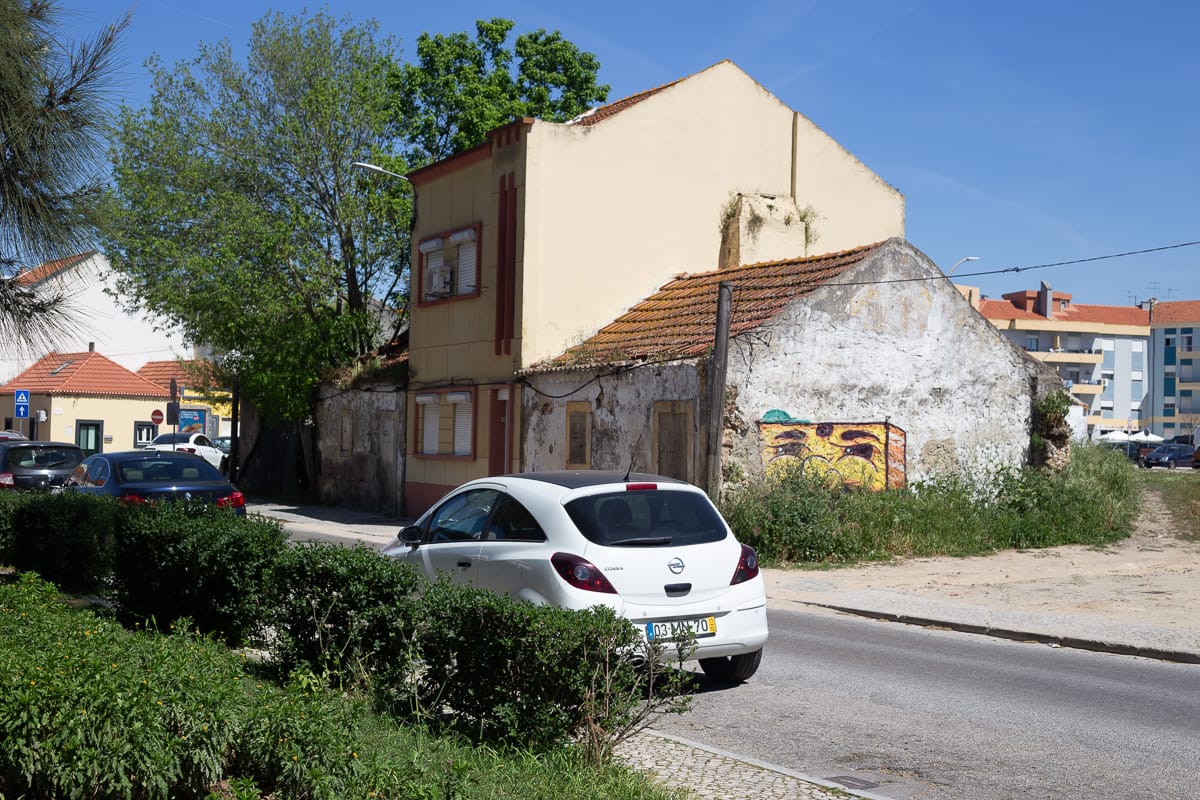 by Jorge Silva “He handed me a pamphlet and suggested I could find the answer there, then said goodbye, smiling.” It is a large garden with a lake, a café, and a few structures for exercise. People walked along the paths, some were training, others were sitting or talking. Near the lake, a group was rehearsing with drums. I came across an older gentleman, well dressed and composed. I introduced myself and asked if I could make a portrait, which he kindly declined. We spoke for a few minutes and ended up exchanging a couple of stories about religion, of all things. As we were about to part, he asked me: “Do you know who controls the world?” He handed me a pamphlet and suggested I could find the answer there, then said goodbye, smiling. I left the park and moved further into the interior of the town. In the narrower streets, houses of different eras stood next to each other — some maintained, others partially abandoned, a few reduced to fragments. I passed through a few small alleys and kept walking. Later, at home, I reached into my back pocket and opened the pamphlet, only to discover that who controls the world is… 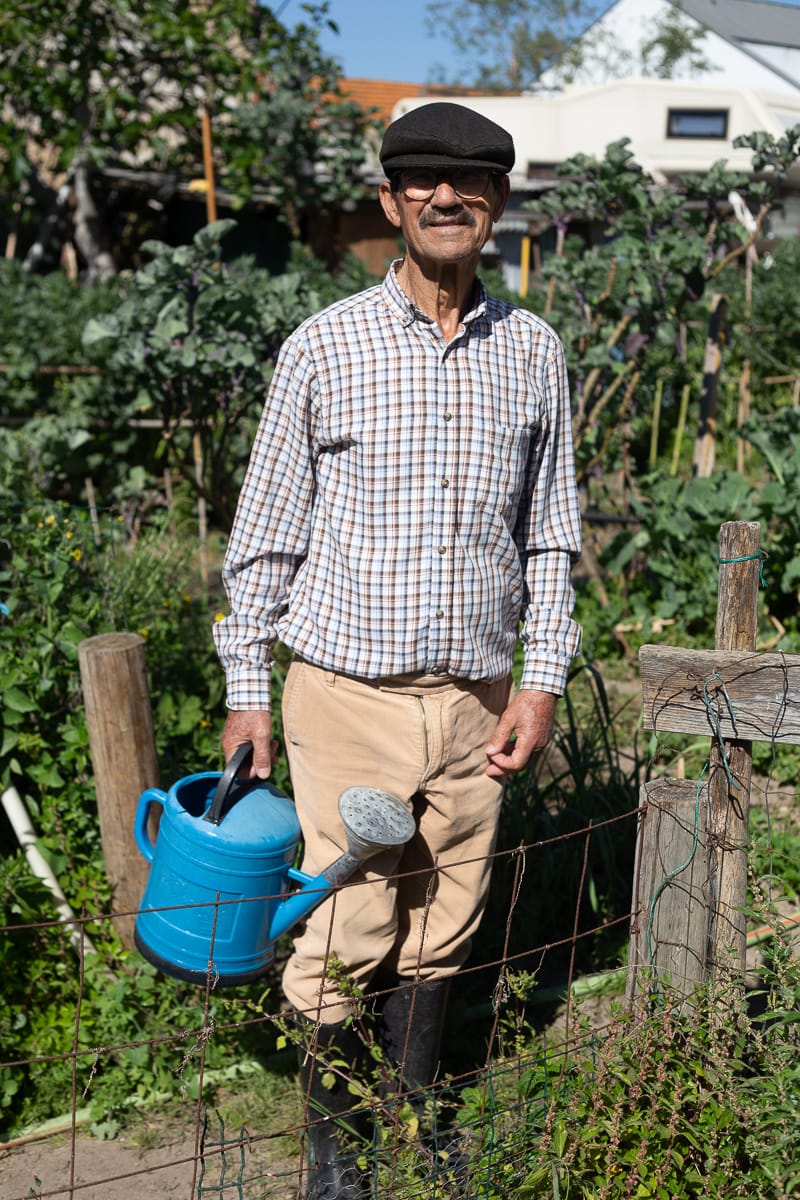 by Jorge Silva |
Visita Guiada
The visual elements of a space, of a landscape, play a fundamental role in constructing the familiarity we call memory. The chromatic palette, the rhythmic density, and the vertical and horizontal distribution of forms give each place the singularity of a fingerprint.
Visita Guiada is my photobook exploring memory, landscape, and the visual traces through which places become familiar.
The book is available here.
Coming Next:
New interview series
A new interview series is in preparation — conversations with voices from the international photography world as well as thinkers and practitioners from related fields. I’ll share more details as soon as the first conversations are ready to unfold.
“The ordinary is a very under-exploited aspect of our lives because it is so familiar.”
Martin Parr
Until next time,