- Galeria Local Newsletter
- Posts
- Issue 15: Burning Photographs and Persistent Landscapes
Issue 15: Burning Photographs and Persistent Landscapes
Reflections on Frampton’s Nostalgia, Jacques’ Nostalgia, and a return to Estrada Real

Jorge Silva
August 20, 2025
GALERIA LOCAL
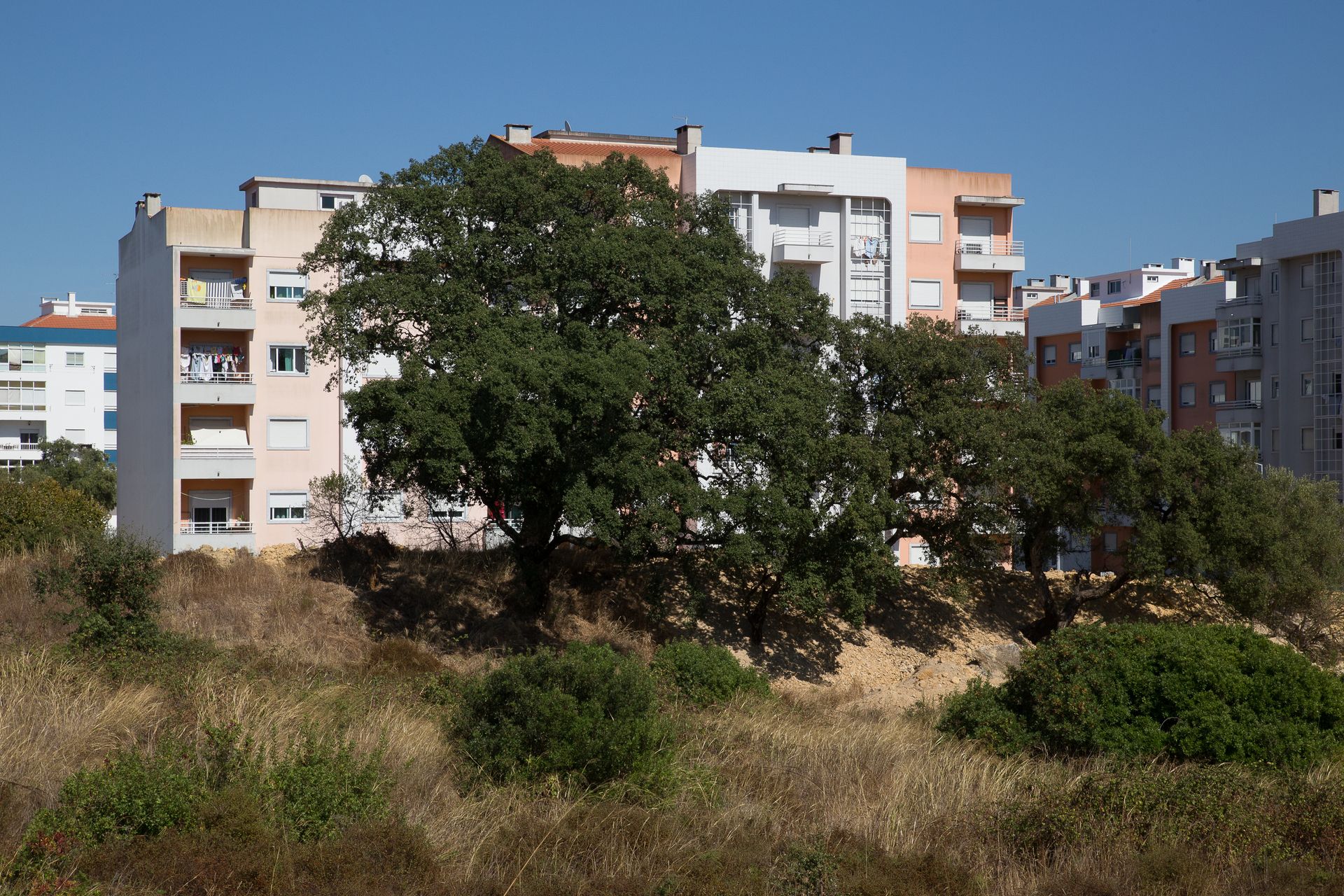
by Jorge Silva
Welcome — and thank you for reading.
This week’s issue opens with an article on Hollis Frampton’s Nostalgia, written as a response to Juliette Jacques’ piece Nostalgia, published in Granta. My text is a commentary — a reflection sparked by hers, where the act of burning a photograph becomes less an erasure than an inscription. Fire, memory, authorship, and performance intersect here, raising questions not only about Frampton’s film but also about how much of ourselves we inscribe into what we write and create.
| Looking ahead, September will bring the opening of Arcadia at Galeria Local, offering a renewed perspective on urban gardens. And next week, Premium subscribers will receive our long-announced interview with Canadian photographer Zackery Hobler, whose contemplative books trace the quiet ties between landscape and emotion. — Jorge |
Commentary
The burning Photograph
In the beginning was the photograph.
It lies flat on a silver plate, resting there as if awaiting some quiet ritual. As we listen to the narrator, smoke begins to rise from beneath the image, soon turning to flame. Fire spreads across the paper, consuming its surface without haste, leaving nothing but the scorched paper, erasing the image into oblivion.
This is the opening scene of Hollis Frampton’s Nostalgia (1971), a short film in which a photograph burns while a voice — not Frampton’s, but the artist Michael Snow’s — narrates a memory. Each photograph, we learn, is shown only after its corresponding story has already been told, creating a temporal dislocation between image and word. The result is a meditation on time, memory, and loss — slow, methodical, and oddly hypnotic.
I recently interviewed Zackery Hobler, a photographer whose book Beneath Two Skies includes an image of a visibly burned photograph — a rupture, a physical trace that interrupts the flow of memory. I mention it here as a note of curious alignment. The conversation will appear in the next issue.
The gesture is symbolic. The fire, theatrical. We are not necessarily letting go. We are staging the action of letting go — rehearsing impermanence within the permanence of its record. What else could it be, in an era of infinite reproducibility? You can't burn the negative and call it final — unless it’s truly unique and no print exists. You can’t even burn the file, not if it’s backed up, cached, or copied. So when we burn a photograph today — and film it — it’s not an act of destruction. It’s a performance.
Frampton’s Nostalgia makes this plain. The images are destroyed as the film unfolds, yet they’re also preserved, forever loopable, repeatable, watchable. This is no act of loss, but of authorship: a chosen frame, a chosen flame. A conceptual decision.
My reflections so far have been shaped by the film itself. But in the Granta article to which I’m responding, Juliette Jacques takes a different path. The film becomes a springboard for self-expression — and the hook of Frampton’s work is slowly overridden by a personal narrative. In the article, this shift happens quickly. What begins as a compelling engagement with the film soon veers toward autobiography — rejection letters, memory loss, gender transition, cultural history, and back again. The balance tips: Frampton’s work becomes less the subject than the pretext, a surface skimmed before diving into a personal account.
Juliette draws a distinction between two modes — one she calls structural, the other confessional. The first relies on form, on detachment, on the architecture of the work. The second opens inward, building intimacy through vulnerability. It’s an interesting dichotomy worth our attention, but one that raises a fair question: how much of ourselves should we bring into what we create? How much is insight — and how much is confession?
Federico Fellini once said: “All art is autobiographical. The pearl is the oyster’s autobiography.” The quote affirms that self-expression is not inherently indulgent, but a natural outcome of creation. At the same time, it helps draw a line — between organic self-revelation as a portal, and opportunistic self-centering, as in commanding a topic for unrelated personal analysis.
The burning bush in the biblical story was a vessel for the divine: fire without destruction, a presence that spoke without consuming.
The burning photograph, as we encounter it in Nostalgia, offers something more ambiguous. Watching those pictures burn — faces dissolving, details curling into blackness — is an eerie experience. The voice describes one image while we witness the disappearance of another. It feels like a dissociation exercise: we are invited to imagine one thing while watching something else disappear. Loss is staged, contained, made observable. And strangely, it lingers.
If the burning bush is the voice of God, the burning photograph is the silence between His words.
Narrative Layers
This week I return to Estrada Real, a project I introduced in the previous issue, photographed between 2020 and 2022. Here I share a few more images and reflections from this territorial study of the Setúbal Peninsula. The work begins on the south bank of the Tagus in Samouco and follows the estuarine edge to Almada, before turning inland through the peninsula’s rural and suburban heart.
Although parts of the region maintain strong economic and commuter links to Lisbon, the territory asserts its own identity: a patchwork of port towns, rural enclaves, fishing communities, and industrial zones that exist outside the city’s cultural and political frame.
ESTRADA REAL
From the River to the Interior
The project begins in Samouco, following the estuarine edge of the Tagus toward Almada. This brackish borderland held fishing settlements, working-class suburbs, and industrial scars — places where water and land pressed against each other in uneasy balance. Makeshift structures for agriculture, animal shelter, or even habitation marked the margins with a quiet architecture of necessity.
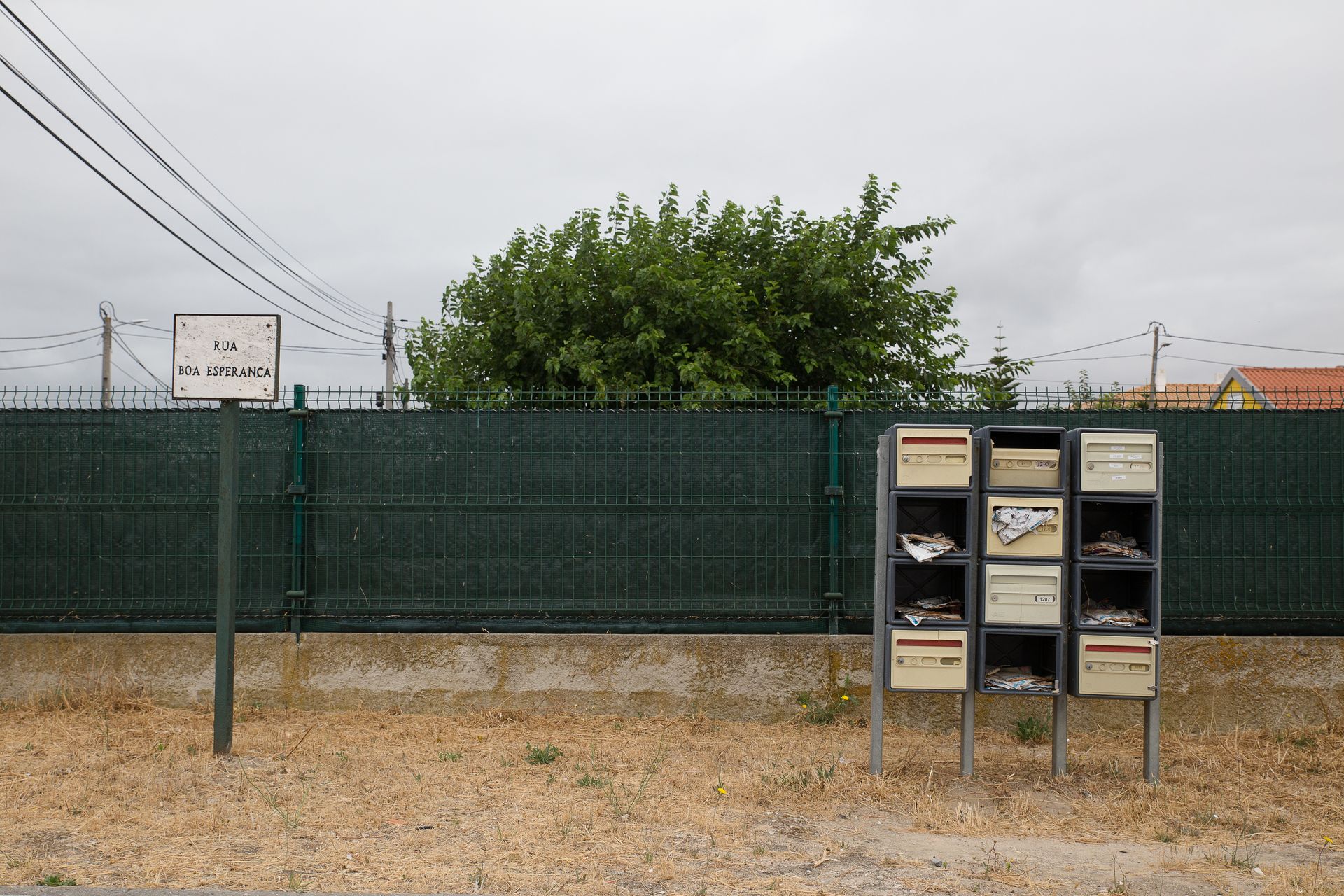 by Jorge Silva From Almada I turned inland, crossing the peninsula through small towns, farmlands, and rural enclaves. Shepherds moved their flocks along roadside fields, wild horses grazed at a distance, and houses ranged from planned to improvised, often built from salvaged materials. It was a territory where cultivated and wild nature overlapped, and where fragments of rural life appeared unexpectedly within suburban streets. “This was a brackish borderland of mudflats, fishing settlements, working-class suburbs, and industrial scars.” Textures and TracesSeen up close, the region unfolded in fragments: clothes drying in alleyways, cement walls painted in leftover pastel, boats stranded in empty lots, bursts of colourful flowers, and fields in full spring bloom. Transmission lines cut across orchards and half-finished buildings, stitching together spaces that otherwise felt disconnected. |  by Jorge Silva “Among them were the exquisite promises of paradise-like visions: some refined, others abandoned, and others slowly succumbing to decay.” The houses followed many different typologies — and in a few cases none at all. Some were carefully planned, others improvised from salvaged materials. Among them were the exquisite promises of paradise-like visions: some refined, others abandoned, others slowly succumbing to decay. 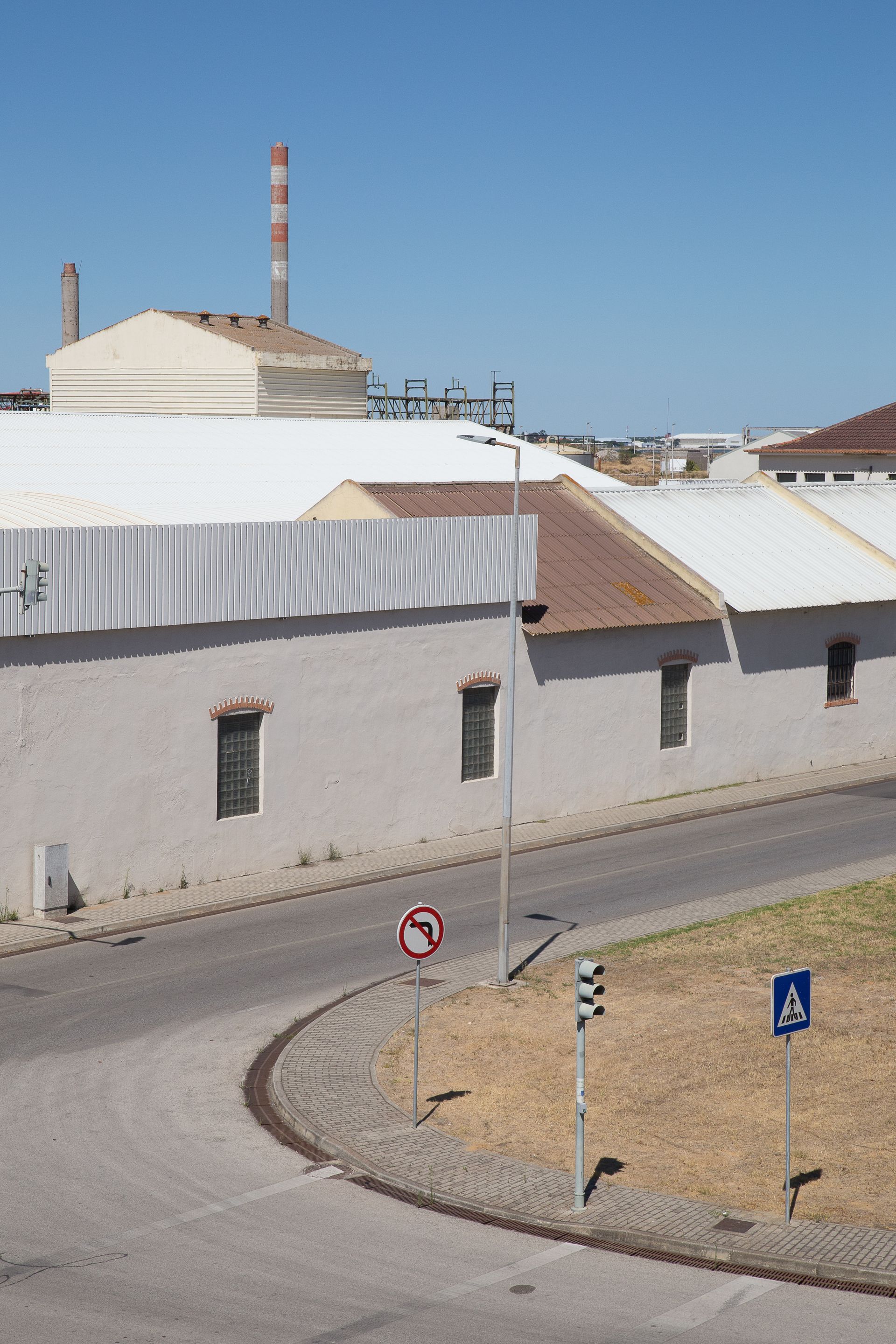 by Jorge Silva |
Arcadia’s Opening – September 2025
Opening at Galeria Local in September 2025, the Arcadia exhibition offers a renewed perspective on urban nature. It invites viewers to see gardens not as static spaces, but as living dialogues — places where human design meets the persistent voice of nature.
Coming Next:
Zackery Hobler
The long-announced conversation with Canadian photographer Zackery Hobler will be published next week in Issue #16 for Premium Subscribers.
If you’d like early access to this interview — along with two extra issues each month — you can upgrade your subscription here.

“The ordinary is a very under-exploited aspect of our lives because it is so familiar.”
Martin Parr
Until next time,