- Galeria Local Newsletter
- Posts
- Issue 14: How Goals Shape What We See
Issue 14: How Goals Shape What We See
Exploring aim in perception, and a visual journey through the Setúbal Peninsula

Jorge Silva
August 12, 2025
GALERIA LOCAL

by Jorge Silva
Welcome — and thank you for reading.
This issue opens with an exploration of how our aims shape what we notice. The main essay, Aiming the Senses, looks at perception not as a neutral recording of reality, but as something built around goals. Drawing on James J. Gibson’s ecological psychology, David Eagleman’s neuroscience, and Jordan Peterson’s symbolic framework, it examines how biology, adaptability, and narrative all guide what comes into view — and what stays invisible. This time, I’ve held back from weaving my own philosophy of photography into these ideas — partly because the concepts stand strongly on their own, and partly because their relevance to visual perception and photography will become clear in this or future essays. | In Narrative Layers, I’m presenting another of my long-term projects, Estrada Real, photographed between 2020 and 2022. I usually work on three or four projects at once, each in a different stage — some still in the field, others being edited — which feels natural for multi-year work. This one traces the Setúbal Peninsula from the Tagus estuary to its rural and suburban heart, following a visual language shaped by both necessity and improvisation. And as always, we close with a look ahead — to our upcoming conversation with Zackery Hobler, arriving in the final August issue. |
Aiming the Senses: How Goals Shape What We Perceive
We rarely look at the world in a neutral way. More often, we look for something. Our senses do not passively record a complete reality and then hand it over to the mind for interpretation. Instead, the mind is already steering the senses, directing them toward certain features of the environment, discarding others. We could say that perception is built upon aim — and without aim, perception would collapse into meaningless noise.
This raises a deeper question: is aim simply a filter applied to perception, or is it the very structure that gives perception its form? Three perspectives — James J. Gibson’s ecological psychology, David Eagleman’s neuroscience, and Jordan Peterson’s symbolic framework — offer complementary answers.
James J. Gibson – Perception as Possibility
In Gibson’s ecological view, perception is not about constructing an internal model of the world from raw sensory data. It is about detecting affordances — the possibilities for action that the environment offers a given organism.
A rock affords sitting for a human but not for an ant; a branch affords perching for a bird but not for a fish. These affordances are not added after the fact by the mind — they are directly perceived. From this perspective, the perceptual system evolved not to record the world in full fidelity, but to register what is relevant to the organism’s survival and purposes.
David Eagleman – The Brain as a Dynamic Filter
Neuroscience deepens this picture by showing how flexible perception can be. David Eagleman’s work on sensory substitution reveals that the brain can repurpose any stream of input into a coherent percept, provided it serves a meaningful purpose.
In one experiment, blind participants wore a vest covered in small vibratory motors, each corresponding to a pixel in a video feed. Over time, they learned to “see” through patterns of vibration on their skin, navigating spaces and recognising shapes. The brain had reinterpreted touch as vision. Similar results came from devices that sent spatial information through pulses on the tongue. What mattered was not the channel but the utility of the signal — whether it served the person’s goals.
Jordan Peterson – Aim as Narrative Compass
Peterson adds a symbolic dimension to the discussion. He argues that our aims are not just utilitarian objectives; they are embedded in narratives that give them meaning.
When we set a goal, we don’t merely identify a target — we place ourselves in a story. Obstacles become enemies, opportunities become allies, challenges become transformations. This symbolic mapping of the world functions as a perceptual schema: it tells us not only what to notice but how to value what we notice.
The three perspectives suggest that aim is not something added after perception but part of its construction from the start. For Gibson, it is rooted in biology: we perceive affordances rather than neutral objects. For Eagleman, it is built into the brain’s adaptability, tuning sensory pathways toward what matters. For Peterson, it is shaped by the narratives that give meaning to what we encounter.
These layers overlap. Biological needs define the possibilities we can register. Personal goals adjust the brain’s sensitivity to them. Cultural and personal narratives give them significance. A change in aim alters the organisation of perception itself — and with it, the world that comes into view.
Narrative Layers
Today I’m presenting another project I photographed between 2020 and 2022 — Estrada Real.
It’s a territorial study of the Setúbal Peninsula, beginning on the south bank of the Tagus in Samouco and tracing a path along the estuarine edge to Almada, before turning inland through its rural and suburban heart. While the northern edge of the peninsula maintains strong economic and commuter links to Lisbon, the territory itself has its own identity — a patchwork of port towns, rural enclaves, fishing communities, and industrial zones that exist beyond the city’s political and cultural boundaries.
ESTRADA REAL
Along the Tagus
The project begins in Samouco and traces a route west along the estuarine edge of the Tagus, toward Almada. This is a brackish borderland of mudflats, fishing settlements, working-class suburbs, and industrial scars. I passed through Montijo, Sarilhos Grandes, Moita, Lavradio, Barreiro, and many others. In each place, I found a tension between water and land, between labor and abandonment. Scattered across the landscape were makeshift structures — built for agriculture, animal shelter, or even informal habitation — forming a quiet architecture of necessity at the margins.
 by Jorge Silva Return Through the Interior
Here the character of the territory shifted. Instead of the river margin, there were open stretches of land, agricultural plots, and clusters of small towns. Shepherds moved their flocks across roadside fields; wild horses grazed at a distance. Greenhouses appeared at irregular intervals, while houses ranged from formally planned to entirely improvised, built from salvaged materials and shaped directly by necessity. Small workshops and clusters of modest homes alternated with expanses of cultivated land.  by Jorge Silva "This is a brackish borderland of mudflats, fishing settlements, working-class suburbs, and industrial scars." 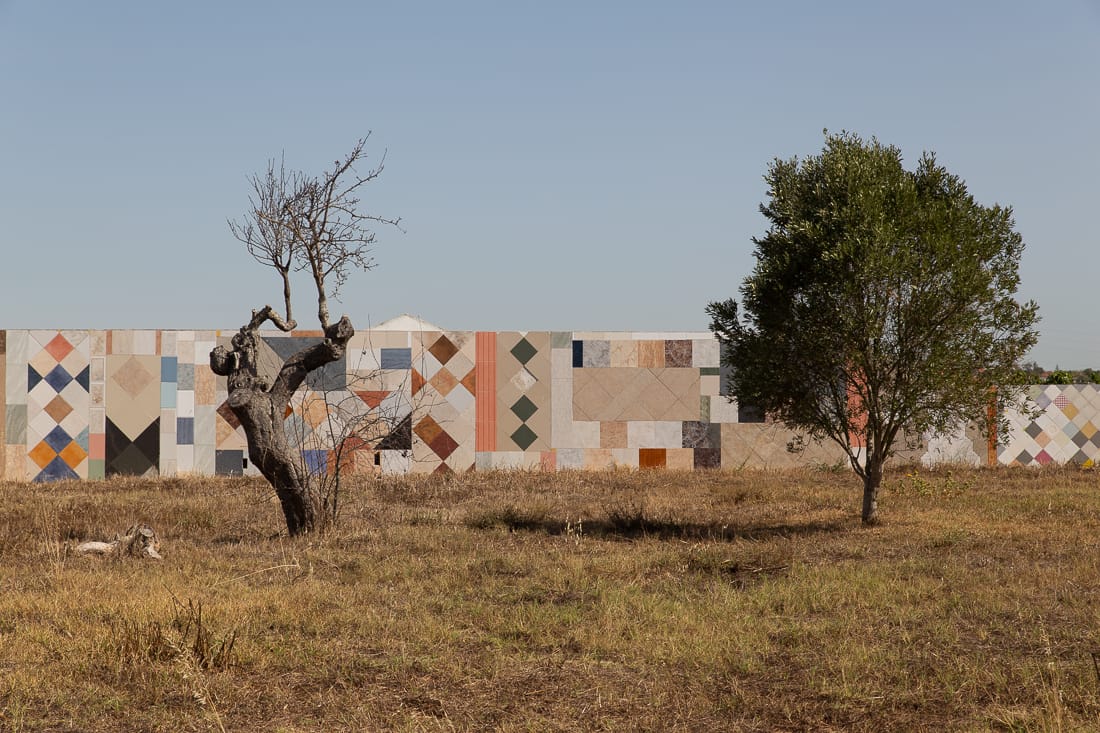 by Jorge Silva |  by Jorge Silva Materials and TexturesSeen up close, the region revealed an unruly mix of surfaces and forms: clothes drying in alleyways, cement walls painted in leftover pastel, boats stranded in empty lots, bursts of colourful flowers, and fields in full spring bloom. Transmission lines crossed the sky above both orchards and half-finished buildings. The houses followed many different typologies — and in a few cases none at all. Among them were the exquisite promises of paradise-like visions: some refined, others abandoned, and others slowly succumbing to decay. This was not a landscape of coherence but one of improvisation, where urban and rural elements met in unpredictable ways to create a visual language built from contradiction. "Among them were the exquisite promises of paradise-like visions: some refined, others abandoned, and others slowly succumbing to decay." Traces of WildnessThe region shifted constantly between the domesticated and the feral. People appeared in my photographs only occasionally; more often it was other presences that caught my attention — dogs moving through empty lots, smoke rising from unseen fires, fences leaning at odd angles, and half-tiled fields under changing light. It was a place where signs of human care and signs of neglect coexisted, each leaving its mark without fully erasing the other.  by Jorge Silva |
Arcadia’s Opening – September 2025
Opening at Galeria Local in September 2025, the Arcadia exhibition offers a renewed look at urban nature, presenting gardens as spaces where human design and nature’s persistence meet in an ongoing conversation.
Coming Next:
Zackery Hobler
The long-announced conversation with Canadian photographer Zackery Hobler will be published next week in Issue #16. As an even-numbered edition, it will be available first to Premium subscribers.
If you’d like early access to this interview — along with two extra issues each month — you can upgrade your subscription here.

by Zackery Hobler
“The ordinary is a very under-exploited aspect of our lives because it is so familiar.”
Martin Parr
Until next time,